Why use Chillers in HVAC? Basics and Key Design Considerations

Chillers are a key part of many larger commercial HVAC systems. Their job is simple in concept. They remove heat from a liquid, usually water, and that cooled liquid is then circulated through cooling coils to cool the air inside a building. In larger facilities, chillers often serve as the backbone of the cooling system because they can handle high loads and support stable indoor conditions. For architects, owners, and project teams, chillers matter because they affect space planning, energy efficiency, maintenance needs, and long-term system performance. Choosing the right chiller is not only about capacity; it is also about how the system will fit into the building and how it will operate over time.
How Do Chillers Work
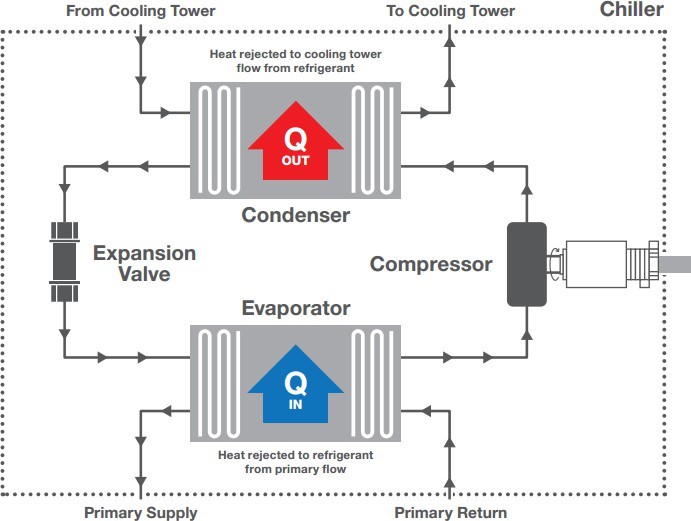
At a basic level, a chiller moves heat from one place to another. It uses refrigerant to absorb heat from the building side of the system and rejects that heat elsewhere. The refrigerant moves through four main stages: compression, condensation, expansion, and evaporation.
Four main components drive this process:
The compressor raises the pressure and temperature of the refrigerant and keeps it moving through the system. Common compressor types include centrifugal, screw, and reciprocating compressors.
The condenser rejects heat and changes the refrigerant from gas to liquid. Condensers can be air-cooled or water-cooled by use of a cooling tower or other heat sink.
The expansion valve lowers refrigerant pressure and temperature before it enters the evaporator. Thermal expansion valves and electronic expansion valves are common options.
The evaporator absorbs heat from the buildings chilled water system, which causes the refrigerant to evaporate back into a gas.
Together, these components create a continuous cycle that removes heat from the building and transfers it out of the system.
Types of Chillers
The two most common HVAC chiller categories are air-cooled and water-cooled chillers.
Air-Cooled Chillers
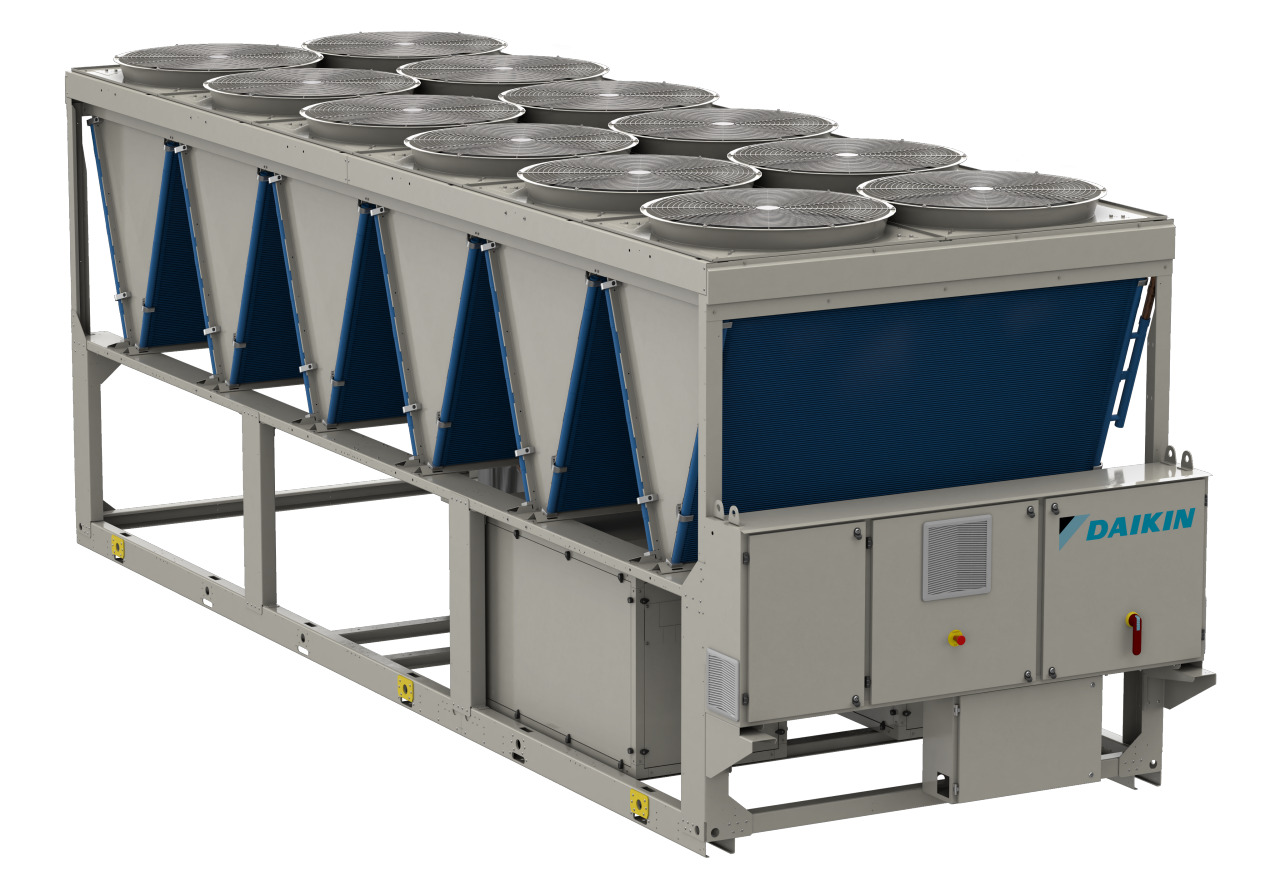
Air-cooled chillers use outdoor ambient air to remove heat from the refrigerant. These systems are often used in smaller buildings or on sites where water availability is limited. They can be a practical option when the project needs a simpler cooling approach with less supporting infrastructure and less skilled maintenance.
Water-Cooled Chillers
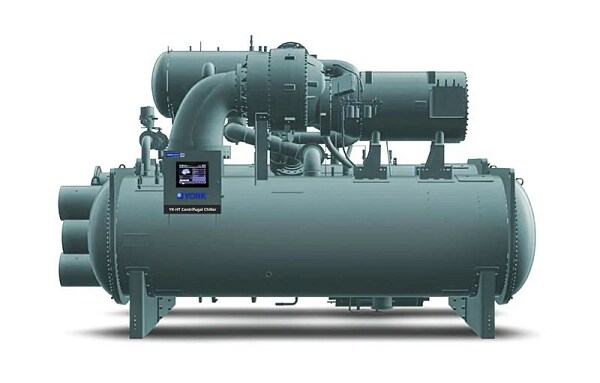
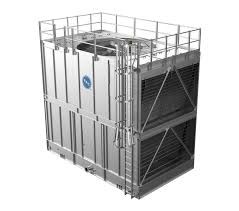
Water-cooled chillers use water to reject heat. These water-cooled systems are typically more efficient than air-cooled systems and are often used in larger buildings where cooling towers can be accommodated. They usually require more infrastructure, but they can offer better performance and efficiency for larger or more demanding applications. The cooling tower allows a large amount of heat to be rejected in a smaller footprint than an air-cooled chiller.
Pros and Cons of Chillers
Like most HVAC systems, chillers offer clear advantages, but they also come with tradeoffs.
Pros
- Effective for large cooling loads
- Can support stable cooling in larger commercial and institutional buildings
- Water-cooled systems can provide higher efficiency for larger applications
- Systems can be designed with redundancy, controls, and energy-saving strategies for better long-term performance
Cons
- Water-cooled systems need more maintenance, including water-side equipment and treatment
- Air-cooled systems are often less efficient than water-cooled systems
- Chiller plants require maintenance access, monitoring, and thoughtful coordination
- Upfront cost can be significant, especially when redundancy, controls, and future expansion are part of the design
Maintenance and Safety
Regular skilled maintenance is essential for chillers to perform their best. Basic maintenance starts with regular inspection of critical components and routine checks for refrigerant leaks. In water-cooled systems, diligent, on-going water treatment is essential to help prevent algae growth, scaling, and corrosion. Safety protocols should be followed throughout operation and maintenance service to reduce the risk of equipment damage, health hazards like legionella, and personal injury.
This must be properly addressed early in design. A chiller system that is not properly designed will not perform as expected and can be difficult to access and harder to maintain. That can affect system reliability, service life, and operating cost.
Design and Engineering Considerations
Good chiller design starts with proper capacity and load selection. Design teams need an accurate cooling load calculation that considers building size, occupancy, internal heat gains, lighting, weather, and the anticipated diversity of those loads. It is important to evaluate both peak and part-load conditions because chillers rarely operate at one steady point all year. Chiller performance and efficiency can vary widely by how well they can match the output capacity to the load on the system.
From there, the system type needs to match the project goals. Air-cooled versus water-cooled selection should reflect efficiency targets, available space, maintenance expectations, and site conditions. Designers should also look at performance metrics like Coefficient of Performance (COP) and Energy Efficiency Ratio (EER), while weighing first cost against long-term energy savings.
Distribution design is another major factor. Piping layout should reduce pressure drop and energy loss. Pump selection should align with the building demand, and variable speed drives can help match chilled water flow to real time operating conditions. Proper hydronic balancing also supports even cooling throughout the building and efficient operation
Controls play a large role as well. Integrating the chiller system with a building automation system (BAS) can improve scheduling, set point control, and performance monitoring. Demand response strategies may also help reduce peak energy costs and improve system resilience.
Energy and sustainability goals should be part of the conversation early. Heat recovery may create value in some projects. Refrigerant choice matters. Code compliance matters. So does lifecycle cost, maintenance access, monitoring, redundancy, and space for future growth. Mechanical room planning and outdoor space allocation can have a direct impact on how well the system fits into the overall building design.
Conclusion
Chillers are one of the most important systems in commercial and institutional HVAC design. They do more than cool a building. They influence energy performance, coordination, maintainability, and long-term operating cost. The right solution depends on the building’s load, the project’s goals, and how well the system is integrated into the overall design.
If you are planning a project that includes chiller systems, contact Schnackel Engineers. We work with project teams to evaluate HVAC options, support coordination early in design, and develop systems that are practical, efficient, and built for long-term performance.
Comments
Comments are closed.