What to Know About Commercial HVAC Refrigerants

Refrigerants are one of the most important parts of a commercial HVAC system, but they are often overlooked during early design conversations. For architects, owners, and project teams, refrigerants affect equipment selection, code compliance, maintenance planning, safety requirements, and long-term operating costs.
As the HVAC industry moves away from higher global warming potential refrigerants, it is useful to understand what refrigerants are, how they are classified, and why current regulations are changing the way commercial systems are designed.
What is an HVAC Refrigerant?
A refrigerant is the working fluid that moves heat through an HVAC system. In a typical cooling cycle, the refrigerant absorbs heat as it evaporates and releases heat as it condenses. This process allows systems such as rooftop units, split systems, VRF systems, chillers, heat pumps, and refrigeration equipment to move heat from one place to another.
The refrigerant itself does not “create” cooling. It makes heat transfer possible. The system’s compressors, coils, expansion devices, piping, and controls all work together to manage that heat transfer safely and efficiently.
In commercial buildings, refrigerant selection can affect much more than equipment performance. It can influence:
- Equipment type and availability
- Energy efficiency
- Environmental impact
- Refrigerant charge limits
- Mechanical room design
- Leak detection requirements
- Ventilation requirements
- Code compliance
- Service procedures
- Replacement planning
- Long-term cost and availability
Environmental impact is one of the main reasons refrigerant selection is changing. Many older refrigerants have high global warming potential, which affects regulations, equipment availability, and long-term replacement planning.
These considerations are more complex in commercial HVAC than in residential air conditioning. Commercial systems are often larger, use a wider range of equipment types, and require closer coordination with architectural, structural, electrical, and fire protection design.
Common Refrigerant Types
Commercial HVAC refrigerants are often grouped by chemical family and environmental impact.
CFCs were used in older systems but are no longer used in new HVAC equipment because of their ozone depletion impact.
HCFCs, such as R-22, were widely used for many years. R-22 has been phased out for new equipment in the United States, and existing systems that still use it can be expensive to maintain due to limited supply.
HFCs, such as R-410A and R-134a, do not deplete the ozone layer, but many have high global warming potential. These refrigerants have been common in commercial HVAC equipment, but regulations are pushing the market toward lower-GWP alternatives.
HFOs and HFO blends are newer refrigerants designed to reduce global warming impact. Many current replacement refrigerants are blends that combine HFCs and HFOs to balance performance, safety, pressure, and environmental goals.
Natural refrigerants, such as ammonia, carbon dioxide, and hydrocarbons, are also used in some applications. These can offer very low GWP, but they come with specific safety, pressure, toxicity, or flammability considerations. They are more common in industrial refrigeration, process cooling, or specialty applications than in typical comfort cooling systems.
Safety Classifications: Toxicity and Flammability
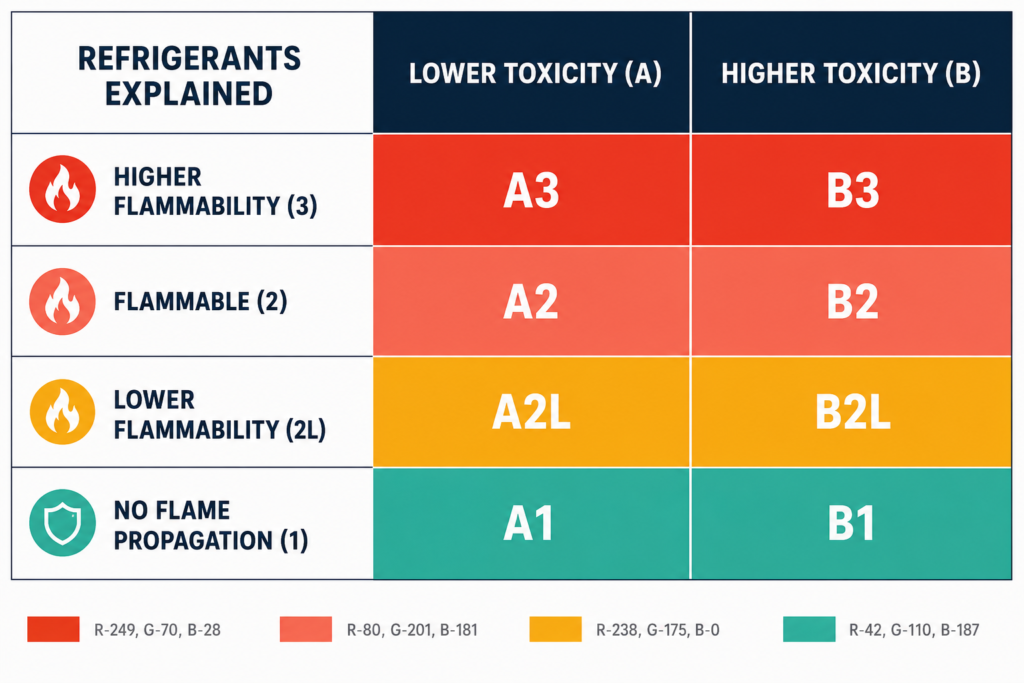
Refrigerants are classified by toxicity and flammability. ASHRAE Standard 34 is the key reference for refrigerant designation and safety classification.
The letter indicates toxicity. Class A refrigerants have lower toxicity. Class B refrigerants have higher toxicity.
The number indicates flammability. Class 1 refrigerants have no flame propagation under test conditions. Class 2L refrigerants have lower flammability and low burning velocity. Class 2 refrigerants are flammable. Class 3 refrigerants are highly flammable. For example, R-410A is classified as A1. Many newer lower-GWP refrigerants, such as R-32 and R-454B, are classified as A2L. That does not mean they are used the same way as older A1 refrigerants. A2L systems require equipment designed and listed for that refrigerant, along with proper installation, service practices, and code compliance.
Why Regulations Are Changing
Refrigerant regulations are mainly driven by two environmental concerns: ozone depletion and global warming potential.
Older CFC and HCFC refrigerants were restricted because of their impact on the ozone layer. Today, the focus is largely on HFCs because many have high global warming potential.
In the United States, the AIM Act (American Innovation and Manufacturing Act) gives EPA authority to address HFCs through phasedown requirements, management of HFC use and reuse, and sector-based restrictions. EPA’s Technology Transitions Program also restricts the use of certain HFCs in specific products and equipment categories.
For commercial HVAC projects, this means teams need to pay close attention to the refrigerant used in new equipment, the applicable compliance dates, and whether the selected system aligns with current and future regulations.
Refrigerant Phaseout, Phasedown, and Transition Timeline
Refrigerant regulation has changed in stages. CFCs and HCFCs were phased out because they contributed to ozone depletion. HFCs are different; they do not deplete the ozone layer, but many have high global warming potential, so they are being phased down and restricted by the equipment sector. For commercial HVAC projects, these changes affect equipment selection, refrigerant availability, service planning, and long-term replacement strategy.
1996: CFC phaseout
New production and import of most Class I ozone-depleting substances, including CFC refrigerants, ended in the United States on January 1, 1996, with limited exemptions. For commercial buildings, CFCs are now mostly a legacy concern in older equipment.
2010: R-22 restrictions for new equipment
HCFC-22, commonly known as R-22, became restricted for new equipment. EPA’s phase-out schedule allowed production and import of HCFC-22 only for use in equipment manufactured before January 1, 2010. This marked a major shift away from R-22 in new HVAC systems.
2020: New R-22 production and import ended
New production and import of HCFC-22 ended in the United States in 2020. Existing R-22 systems may still operate, but service depends on available recovered, recycled, reclaimed, or previously produced refrigerant.
2022 to 2023: HFC phasedown begins
Under the AIM Act, EPA began phasing down HFC production and consumption through an allowance program. As of January 1, 2022, allowances were required to produce or import bulk HFCs, and the phasedown schedule capped production and consumption at 90 percent of baseline levels.
2024 to 2028: HFC phasedown deepens
2024 through 2028, the HFC production and consumption cap drops to 60 percent of baseline levels. In practical terms, this 40 percent reduction is one of the reasons manufacturers and project teams are moving toward lower-GWP refrigerant options.
2025: First major HFC Technology Transitions restrictions begin
Beginning January 1, 2025, certain technologies may no longer use high-GWP HFCs or HFC blends. For HVAC-related applications, EPA lists a 700 GWP limit for many comfort cooling chillers, ice rink chillers, and stationary residential and light commercial air conditioning and heat pump systems.
2026: Additional chiller and industrial process refrigeration restrictions
Additional restrictions begin for certain industrial process refrigeration applications. EPA lists a 700 GWP limit for some industrial process refrigeration chillers with exiting fluid temperatures above -30°C, along with 150 or 300 GWP limits for certain industrial process refrigeration systems depending on refrigerant charge size and system configuration.
2027: VRF and data center cooling restrictions
EPA lists a 700 GWP limit for variable refrigerant flow systems beginning January 1, 2027. EPA also lists a 700 GWP limit for data centers, computer room air conditioning, and information technology equipment cooling beginning January 1, 2027.
2028: Additional lower-temperature refrigeration restrictions
More restrictions will apply to certain lower-temperature industrial process refrigeration applications. EPA lists a 700 GWP limit for some chillers and industrial process refrigeration systems operating between -50°C and -30°C, along with a 300 GWP limit for refrigerated laboratory centrifuges and laboratory shakers.
2029 to 2033: HFC phasedown reaches 30 percent of baseline
From 2029 through 2033, the HFC production and consumption cap will drop to 30 percent of baseline levels, which represents a 70 percent reduction from baseline. EPA also lists reclaimed HFC requirements for servicing and repair in selected refrigeration, air conditioning, and heat pump subsectors beginning January 1, 2029.
2030: Complete HCFC production and import phaseout
EPA’s HCFC schedule culminates in 2030, when new production and import of all HCFCs will end in the United States.
2032: Tighter limits for some commercial refrigeration systems
For certain commercial refrigeration subsectors, EPA lists interim GWP limits before tighter limits take effect in 2032. This includes some cold storage warehouses, supermarket systems, and retail food remote condensing units, where limits may tighten to 150 or 300 GWP depending on refrigerant charge size and system configuration.
2034 to 2035: HFC phasedown reaches 20 percent of baseline
From 2034 through 2035, the HFC production and consumption cap will drop to 20 percent of baseline levels, which represents an 80 percent reduction from baseline.
2036 and beyond: Long-term HFC phasedown target
Beginning in 2036, HFC production and consumption will be capped at 15 percent of baseline levels. This represents the AIM Act’s long-term 85 percent phasedown target.
These dates do not mean every existing system must be replaced immediately. In many cases, existing equipment can continue to operate. The bigger impact is on new equipment, refrigerant availability, retrofit decisions, and long-term maintenance planning. EPA notes that Technology Transitions restrictions generally apply to new products and systems after the relevant compliance date, not to products and systems already installed and in use before that date.
For commercial projects, the key takeaway is to confirm the proposed refrigerant, equipment/system type, GWP limit, and applicable compliance date early in design. Requirements vary by equipment category, and local code adoption can also affect how new refrigerants, including A2Ls, are applied in buildings.
The Shift Toward A2L Refrigerants
One of the biggest changes in commercial HVAC is the shift toward A2L refrigerants. These refrigerants have lower global warming potential than many legacy HFCs, but they are mildly flammable. Because of that, their use affects codes, standards, equipment design, installation practices, and service training. AHRI’s Safe Refrigerant Transition resources provide guidance on A2L safety, installation, servicing, model codes, and retrofit considerations.
A2L refrigerants are not drop-in replacements. An existing R-410A system cannot simply be charged with an A2L refrigerant. The equipment must be designed, rated, and listed for the specific refrigerant.
This matters during renovations and replacements. If a project includes partial equipment replacement, existing coils, piping, controls, refrigerant detection, and ventilation provisions may need to be reviewed before the design direction is finalized.
Code and Design Considerations
Commercial refrigerant design is not only an equipment issue. It is also a code coordination issue.
Depending on the system type, refrigerant charge, location, occupancy, and equipment arrangement, the design may need to address:
- Maximum refrigerant charge
- Refrigerant concentration limits
- Machinery room requirements
- Ventilation
- Leak detection
- Alarm systems
- Access and service clearances
- Pipe routing
- Refrigerant storage
- Coordination with local code officials
The International Mechanical Code includes requirements for refrigeration systems, including machinery rooms and refrigerant safety provisions. The 2024 I-Codes also include updates that help address the use of A2L refrigerants.
Because code adoption varies by jurisdiction, the design team should confirm local requirements early. This is especially important for commercial buildings with larger refrigerant charges, VRF systems, central plants, or equipment located near occupied spaces.
What Building Teams Should Watch For
For architects and owners, the biggest takeaway is that refrigerant decisions should not be left until late in design. They can affect space planning, equipment layout, shafts, roof coordination, mechanical rooms, electrical needs, maintenance access, and future replacement strategies.
During design, project teams should ask:
- What refrigerant does the proposed equipment use?
- Is the refrigerant allowed for this application?
- What is its safety classification?
- What is the system refrigerant charge?
- Are leak detection or ventilation measures required?
- Does the local jurisdiction allow the proposed refrigerant and system type?
- How will this equipment be serviced over its expected life?
- Is there a long-term replacement or retrofit concern?
These questions help avoid coordination issues and reduce the risk of late design changes.
Final Takeaway
Commercial HVAC refrigerants are changing because equipment manufacturers, codes, and regulations are moving toward lower-GWP options. This transition affects more than the refrigerant cylinder. It affects equipment selection, safety requirements, code compliance, and building coordination.
For project teams, the best approach is to identify refrigerant requirements early, coordinate with the mechanical engineer, and confirm local code requirements before major equipment decisions are locked in. Refrigerants may be a technical detail, but they can have a real impact on cost, schedule, safety, and long-term building operation.
As refrigerant requirements continue to change, early HVAC coordination can help keep commercial projects aligned with code, equipment availability, and long-term building goals. Contact Schnackel Engineers to discuss your next project.
Glossary of Refrigerant Terms and Acronyms
A1
A refrigerant safety classification for refrigerants with lower toxicity and no flame propagation under standard test conditions. R-410A is a common example.
A2L
A refrigerant safety classification for refrigerants with lower toxicity and lower flammability. Many newer lower-GWP refrigerants fall into this category.
A3
A refrigerant safety classification for refrigerants with lower toxicity and higher flammability. Propane, also known as R-290, is an example.
CFC
Chlorofluorocarbon. An older class of refrigerants with ozone depletion potential. CFCs have been phased out of new production in the United States.
GWP
Global warming potential. A measure of how much heat a greenhouse gas traps in the atmosphere compared with carbon dioxide over a specific period.
HCFC
Hydrochlorofluorocarbon. A class of refrigerants developed as a replacement for CFCs, but later phased out due to ozone depletion potential. R-22 is a common example.
HFC
Hydrofluorocarbon. A class of refrigerants with no ozone depletion potential, but many HFCs have high global warming potential. R-410A and R-134a are common examples.
HFO
Hydrofluoroolefin. A newer class of lower-GWP refrigerants used in some HVAC and refrigeration applications.
IMC
International Mechanical Code. A model code used by many jurisdictions for mechanical systems, including refrigeration system requirements.
ODP
Ozone depletion potential. A measure of a substance’s potential to damage the ozone layer compared with a reference substance.
R-22
An HCFC refrigerant formerly used in many HVAC systems. New production and import of R-22 ended in the United States in 2020.
R-410A
An HFC refrigerant commonly used in air conditioning and heat pump systems. It has been widely used in commercial HVAC, but newer equipment is shifting toward lower-GWP alternatives.
R-454B
A lower-GWP A2L refrigerant used as a replacement option in some newer HVAC equipment.
VRF
Variable refrigerant flow. A commercial HVAC system type that uses refrigerant to serve multiple indoor zones from one or more outdoor units.
References
- EPA: Phaseout of Class I Ozone-Depleting Substances
- EPA: Phaseout of Class II Ozone-Depleting Substances
- EPA: Frequent Questions on the Phasedown of Hydrofluorocarbons
- EPA: Technology Transitions HFC Restrictions by Sector
- ASHRAE: Refrigerant Designations
- AHRI: Safe Refrigerant Transition
- California Air Resources Board: High-GWP Refrigerants
Comments