Understanding the Basics of Central Utility Plants
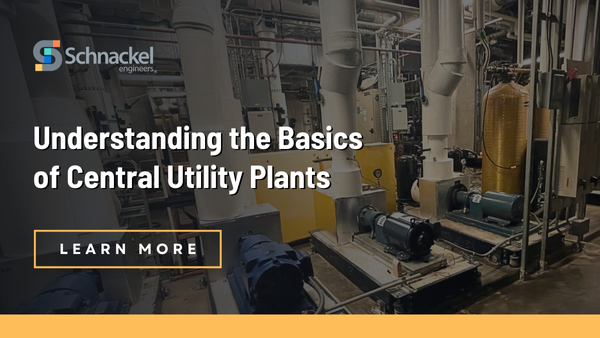
In many large buildings and multi-building facilities, heating and cooling are not produced inside each individual structure. Instead, these services are generated from a centralized location known as a central utility plant. Central utility plants serving very large installations can include on-site power generation for emergency power and even normal power in the case of a Total Energy Plant.
Central utility plants support a wide range of facilities by consolidating major mechanical and energy infrastructure into a single location. Understanding how these systems work, and how they differ from building-based, distributed systems, can help inform early planning and design decisions.
What Is a Central Utility Plant?
A central utility plant (CUP) is a dedicated facility that produces heating, cooling, and sometimes electrical power from a single, centralized location and distributes those utilities to one or more buildings.
Instead of each building operating its own boilers, chillers, or major mechanical equipment, a central utility plant consolidates this infrastructure into a shared system designed to serve a larger combined load. This allows for higher levels of load diversification and even greater energy savings, if done right.
A Total Energy Plant combines the functions of the central utility plant with full electrical power generation, achieving even higher efficiencies through waste heat recovery from the generators.
In simple terms, a central utility plant acts as the core mechanical and energy hub for a facility or campus.
What Does a Central Utility Plant Provide?
Depending on the needs of the project, a central utility plant may generate:
Heating
- Hot water or steam for space heating
- Domestic hot water
- Process or industrial heating
Cooling
- Chilled water for air conditioning
- Process cooling for specialized equipment
Electrical Power (When Applicable)
- Primary electrical distribution
- Emergency or standby power
- On-site power generation
These utilities are distributed to buildings through piping and electrical networks designed as part of the overall facility infrastructure.
How Is This Different from Typical Building Systems?
In many smaller or standalone buildings, mechanical systems are located within, or adjacent to, the building itself. These building-based systems serve only that structure.
A central utility plant differs in that:
- Energy is produced in one centralized location
- Multiple buildings are served by shared equipment
- Major mechanical systems are removed from individual buildings
Both approaches are widely used. The right choice depends on the size, complexity, and long-term goals of the project.
The Benefits of Central Utility Plants
Central utility plants are often used because they offer several practical advantages for larger or more complex facilities.
Improved Efficiency
Designed correctly, larger, centralized equipment can operate more efficiently than multiple smaller systems. Serving multiple buildings also allows systems to take advantage of variations in occupancy patterns, reducing overall energy demand.
Greater Load Diversity
Centralized equipment sizing is based on the diversified load over a larger number of buildings and a larger total building area. Individual building systems must be sized for the peak loads of that singular building. Central utility plant sizing can take advantage of the fact that all buildings will not have coincident peak demands, so the overall capacity of the system can be shared among the connected buildings based on their instantaneous needs. This results in lower required overall capacities and the resultant cost savings.
Streamlined Operations and Maintenance
By consolidating major mechanical equipment into one location, maintenance activities are centralized, making systems easier to monitor, service, and manage over time. There is also less disruption to the occupied buildings due to the reduced amount of mechanical and plumbing equipment required in each building.
Reliability and Resiliency
Central utility plants can be designed with higher levels of built-in redundancy, allowing critical systems to remain operational during maintenance or equipment outages.
Long-Term Flexibility
Central utility plants can be planned to accommodate future growth, renovations, or additional buildings without duplicating major infrastructure.
Space Savings within Buildings
Additional valuable interior space can be utilized for program use rather than being devoted to huge heating, cooling, and power equipment.
Where Central Utility Plants Are Commonly Used
Central utility plants are most often found in environments such as:
- Hospitals and healthcare campuses
- Universities and research institutions
- Data centers and mission-critical facilities
- Airports and transportation hubs
- Large mixed-use or campus-style developments
- Large shopping malls and multi-building retail centers
These settings typically require high reliability, long operating hours, and infrastructure that can adapt over time.
How Central Utility Plant Delivery Is Evolving
Traditionally, central utility plants have been constructed entirely on site, with equipment installed, piped, wired, and commissioned in the field. While this approach remains common, it is no longer the only way central utility plants are delivered.
Today, owners and project teams are increasingly exploring alternative delivery methods, including modular, packaged, and skid-mounted central utility plant solutions. These approaches shift portions of fabrication and assembly off site, which can help address challenges such as:
- Compressed construction schedules
- Limited on-site labor
- Space or access constraints
- Phased development plans
- Lower labor costs for off-site labor
While the engineering principles behind central utility plants remain the same, the way those systems are assembled and installed is changing—creating new options for how central utility plants fit within modern project delivery.
A Strategic Infrastructure Decision
Choosing to use a central utility plant is not just a mechanical decision; it’s also a planning and infrastructure decision that might have an impact on:
- Project phasing
- Construction coordination
- Operations and staffing
- Energy strategy
- Long-term lifecycle costs
Because of this, central utility plants must be evaluated early in the design process.
Conclusion
Central utility plants provide a consolidated way to deliver heating, cooling, and power to buildings that share common infrastructure needs. By combining major systems into a single facility, they can offer efficiency, reliability, space savings, and flexibility that individual building systems may not provide at scale.
Understanding the basics of central utility plants is an important first step in evaluating both traditional and modern utility delivery approaches and determining which strategy best aligns with a project’s goals.
At Schnackel Engineers, we help owners and project teams evaluate all utility plant strategies early in planning, including how different delivery approaches may impact cost, schedule, operations, and long-term performance.
If you are planning a new facility, campus expansion, or major renovation and want to better understand your infrastructure options, contact us to start a conversation with our engineering team and explore the approach that best aligns with your project goals.
Comments