Air-Cooled vs. Water-Cooled Chillers: What’s the Difference?
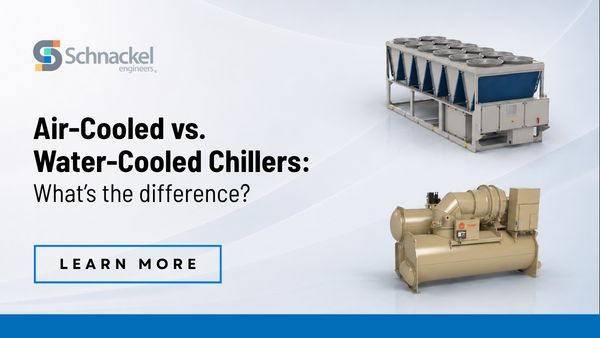
Chillers are used in many commercial and institutional HVAC systems because they can support large cooling loads, provide stable indoor conditions, and offer long-term system energy performance. As discussed in our related blog, Why Use Chillers in HVAC: Basics and Key Design Considerations, the right chiller system depends on load, efficiency goals, available space, maintenance needs, and project priorities.
Two of the most common chiller types are air-cooled chillers and water-cooled chillers. Both remove heat from a building, but they reject that heat in different ways. That difference affects efficiency, space planning, installation cost, maintenance cost, and where each system makes the most sense.
This blog compares air-cooled and water-cooled chillers, including their pros, cons, applications, and best project fits.
What Is an Air-Cooled Chiller?
An air-cooled chiller uses outdoor air directly to reject heat from the refrigerant. Heat is transferred from the building’s chilled water loop to the refrigerant, and then released to the outdoors through condenser coils and fans.
Air-cooled chillers are usually installed outdoors, often on rooftops, grade-level pads, or other exterior equipment areas. Since they do not require a cooling tower or condenser water loop, they are often simpler to install and easier to coordinate on smaller or space-constrained projects.
Pros of Air-Cooled Chillers
Air-cooled chillers can be a practical choice for many building types, especially when simplicity and lower maintenance costs are priorities.
Key advantages include:
- No cooling tower required
- No condenser water system required
- No water use for heat rejection
- Packaged units available that included pumps, piping, and controls
- Simpler installation compared to water-cooled systems
- Less water treatment and water-side maintenance
- Good fit for smaller and mid-sized commercial buildings
- Useful where water availability, water cost, or water restrictions are concerns
Because air-cooled chillers use ambient air for heat rejection, they reduce the need for additional water-side equipment. This can simplify design coordination and reduce the maintenance burden for owners.
Cons of Air-Cooled Chillers
The main tradeoff is efficiency. Air-cooled chillers are typically less efficient than water-cooled chillers, especially in larger applications or during high outdoor air temperatures.
Common limitations include:
- Lower efficiency compared to water-cooled systems
- Performance can be affected by outdoor air temperature
- Larger outdoor equipment footprint required for larger capacities
- More exterior noise from fans and compressors
- Rooftop structural coordination may be required
- Less ideal for very large or high-load facilities
Air-cooled chillers can perform well when properly selected and applied. However, they may not be the best option when the project has high cooling loads, strict energy targets, or long operating hours.
Best Applications for Air-Cooled Chillers
Air-cooled chillers are a goodfit for projects where the system needs to be simple, reliable, and easier to maintain.
Common applications include:
- Small to mid-sized commercial buildings
- Office buildings
- Retail facilities
- Schools
- Low-rise and mid-rise buildings
- Renovations where adding a cooling tower is difficult
- Buildings with limited space in the mechanical room
- Projects where water use must be minimized
- Sites without viable space for cooling towers
Air-cooled chillers are useful when project teams want to avoid the added coordination, maintenance, and water treatment requirements of a water-cooled system.
What is a Water-Cooled Chiller?
A water-cooled chiller uses water to reject heat. The system transfers heat from the building’s chilled water loop to the refrigerant, then from the refrigerant to a condenser water loop. That heat is typically rejected outdoors through a cooling tower.
Water-cooled chillers are often used in larger buildings because they can provide higher efficiency and better performance for large cooling loads. They require more infrastructure, but they can offer long-term energy savings when the project scale and operating requirements support the added complexity.
Pros of Water-Cooled Chillers
Water-cooled chillers are often selected for larger buildings and more demanding applications because they operate more efficiently than air-cooled systems.
Key advantages include:
- Higher efficiency for large-load applications
- Better system performance for larger buildings
- Longer equipment life potential when properly maintained
- Smaller outdoor footprint compared to equivalent air-cooled capacity
- Better suited for buildings with long operating hours
- Can support redundancy and staged operation
Because water is more effective than air at releasing heat into the atmosphere due to evaporation, water-cooled systems provide better performance than air-cooled systems. This is due to the latent heat of vaporization that occurs when water evaporates, releasing immense amounts of heat from the water in the cooling tower system.
Cons of Water-Cooled Chillers
Water-cooled chillers require more supporting equipment and more maintenance. This includes cooling towers, condenser water pumps, piping, controls, and water treatment.
Common limitations include:
- Higher system complexity
- More maintenance than air-cooled systems
- Water treatment essential to continued performance of the system
- Higher first cost in many applications
- Requires indoor space for chiller units, while the cooling tower(s) is typically outdoors
- More coordination for mechanical rooms, rooftops, or exterior tower locations
- Potential concerns with scaling, corrosion, biological growth, and water quality
- Requires skilled maintenance staff or service support
Water-cooled systems can provide excellent efficiency, but that performance depends on proper design, maintenance, and operation. If the owner does not have the staff and resources to maintain the system, performance will decline over a very short period.
Best Applications for Water-Cooled Chillers
Water-cooled chillers are often best for larger facilities with higher cooling loads, longer operating hours, longer lifespans and more demanding performance needs.
Common applications include:
- Hospitals
- Universities
- Laboratories
- Large office buildings
- High-rise buildings
- Hotels
- Large mixed-use developments
- Data centers
- Industrial facilities
- Central utility plants
- Buildings with high cooling demand and long run times
Water-cooled chillers are worth considering when energy efficiency, life cycle cost, and long-term performance carry more weight than first cost alone.
Air-Cooled vs. Water-Cooled Chillers: Key Differences
The best chiller type depends on the project. Air-cooled chillers are usually simpler and require less maintenance. Water-cooled chillers are usually more efficient for larger systems but need more infrastructure and maintenance.
| Factor | Air-Cooled Chillers | Water-Cooled Chillers |
| Heat rejection method | Uses outdoor air | Uses water and a cooling tower |
| Typical efficiency | Lower than water-cooled | Higher than air-cooled |
| Water use | Low | High |
| Maintenance | Less complex | More complex |
| First cost | Often lower for smaller systems | Often higher due to added equipment |
| Best fit | Small to mid-sized buildings | Larger buildings and central plants |
| Space needs | Outdoor equipment area | Mechanical room plus cooling tower location |
| System complexity | Simpler | More complex |
| Owner maintenance needs | Lower | Higher |
| Long-term energy performance | Good for the right application | Often better for large, high-load facilities |
Why Early Coordination Matters
Chiller selection should happen very early in design. Waiting too long can create space, access, coordination, and higher cost issues later.
Architects and project teams should consider:
- Where the chiller and/or cooling tower will be located
- How equipment will be screened or integrated into the building design
- Whether roof structure can support the required equipment loads
- What interior space is available for equipment
- How maintenance staff will access the system
- How sound may affect nearby spaces or neighboring properties
- Whether the system supports future expansion
- How the chiller selection affects energy goals and operating cost
- Whether the owner can maintain the selected system properly
The best chiller system is not just the one that meets the cooling load. It is the one that fits the building, supports the owner’s goals, and can be maintained over the life of the facility.
Conclusion
Air-cooled and water-cooled chillers both serve an important role in commercial HVAC design, but they are suited for different project needs.
Air-cooled chillers are often a strong choice for smaller and mid-sized buildings, renovations, and projects where lower water use and simplified maintenance are priorities. Water-cooled chillers are often better for larger buildings, high cooling loads, and projects where long-term efficiency and central plant performance matter most.
The right choice depends on how the system fits the building, the site, the owner’s maintenance capabilities, and the project’s long-term performance goals.
If you are planning a project that includes a chiller system, contact Schnackel Engineers. We help project teams evaluate HVAC options, coordinate system requirements early in the design process, and develop practical solutions that support performance, maintainability, and long-term value.
Comments